AI needs a lot of power. Data centers are being built at a pace the grid hasn't seen in decades, and that isn't going to slow down.
A new Harvard study shows what that costs. America's 403 largest data centers emitted about 25.7 million metric tons of CO₂ in one year, about as much as the entire country of Denmark (TIME, The New York Times). And that's an undercount. It doesn't include on-site gas turbines or the methane that leaks from wells before the gas reaches a power plant (Heated).
We're already working with data center developers and AI buyers to cut emissions at the source, in the communities where they build.
The numbers only go up
Ten years ago, data center power demand was growing slowly. Then cloud computing took off, and now AI. Training and running large models takes far more power than the web services that came before, and every major tech company is racing to build capacity.
U.S. data center electricity use tripled in a decade, and it could triple again by 2028. Globally, the IEA expects data center demand to more than double by 2030, with the U.S. driving the biggest share of that growth. Emissions are rising with it.
- U.S. data center electricity, 2014 to 2023: 58 to 176 TWh, or 4.4% of U.S. power (Berkeley Lab)
- U.S. data center electricity by 2028: 325 to 580 TWh, or 6.7% to 12% of U.S. power (Berkeley Lab)
- Global data center electricity, 2024 to 2030: 415 to 945 TWh (IEA via DatacenterDynamics)
- Global data center power emissions by 2035: from about 180 Mt today to 300 to 500 Mt CO₂ (IEA via DatacenterDynamics)
- Big Tech electricity use, 2022 to 2025: up 240% (Climate Action Against Disinformation, via AP)
- Microsoft emissions, FY24 to FY25: 16.2 to 20.3 Mt CO₂e, up 25% (TechRadar)
A lot of it will run on gas
The grid can't add clean power fast enough, so many data centers are building their own gas plants. The U.S. has about 252 GW of gas power in development, more than any other country, and over a third of it is meant to power data centers directly (Global Energy Monitor).
That gas comes from wells, and the oldest ones leak. The U.S. has about half a million marginal wells: old, low-production oil and gas wells. Together they emit roughly half of all methane from U.S. well sites (Omara et al., via EDF). None of it shows up in a data center's emissions report.
Communities are noticing
Local opposition blocked or delayed about $130 billion in data center projects in the first quarter of 2026 alone (Data Center Watch). In 40 of 41 recent local ballot measures, voters chose to limit or stop new data centers (TIME). The concerns are local: power bills, water, noise and air pollution.
For AI companies, social license to operate is now a real constraint on growth.
Clean power alone won't win the neighbors
Data centers can and should buy clean power, run efficiently and report everything they emit. Where a site sits can change its emissions by up to 7x (TIME).
But the footprint is still growing fast. And none of it is something the neighbors can see.
The wells are next door
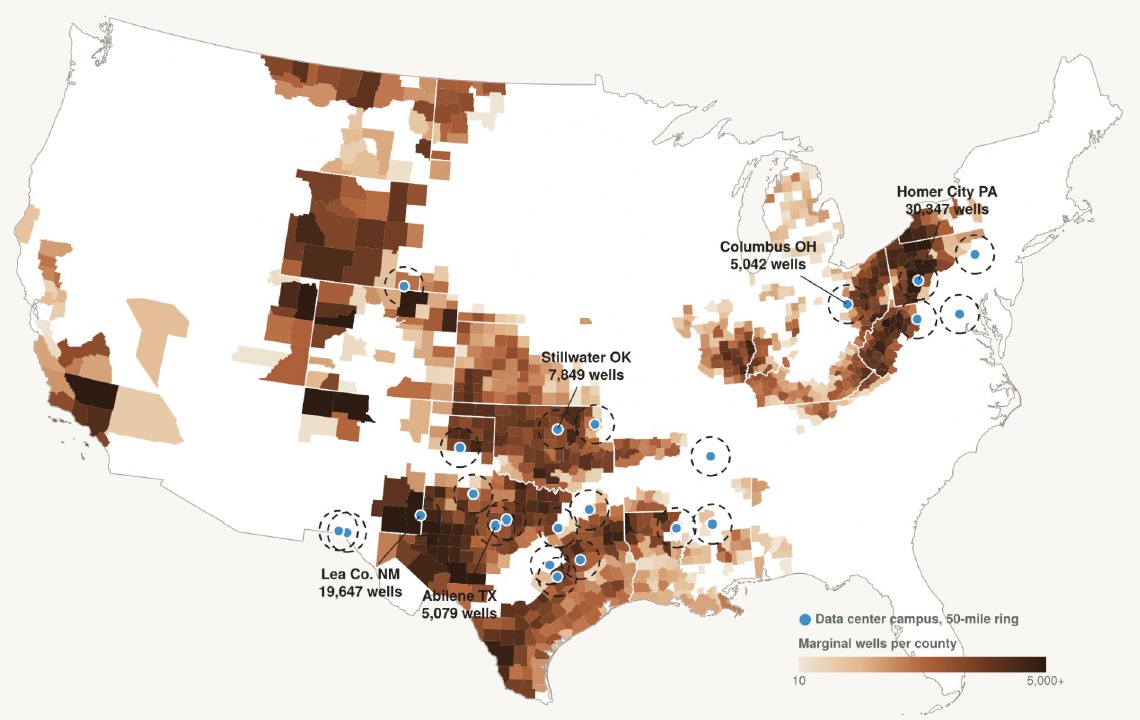
Data centers are being built in the oilfields. When we mapped major data center campuses against RMI's marginal well data, most had more than a thousand marginal wells within 50 miles. One campus in western Pennsylvania has more than 30,000.
The basins that supply the gas also hold the wells that leak it. Plugging those wells cuts emissions close to the data center.
Plug them for good
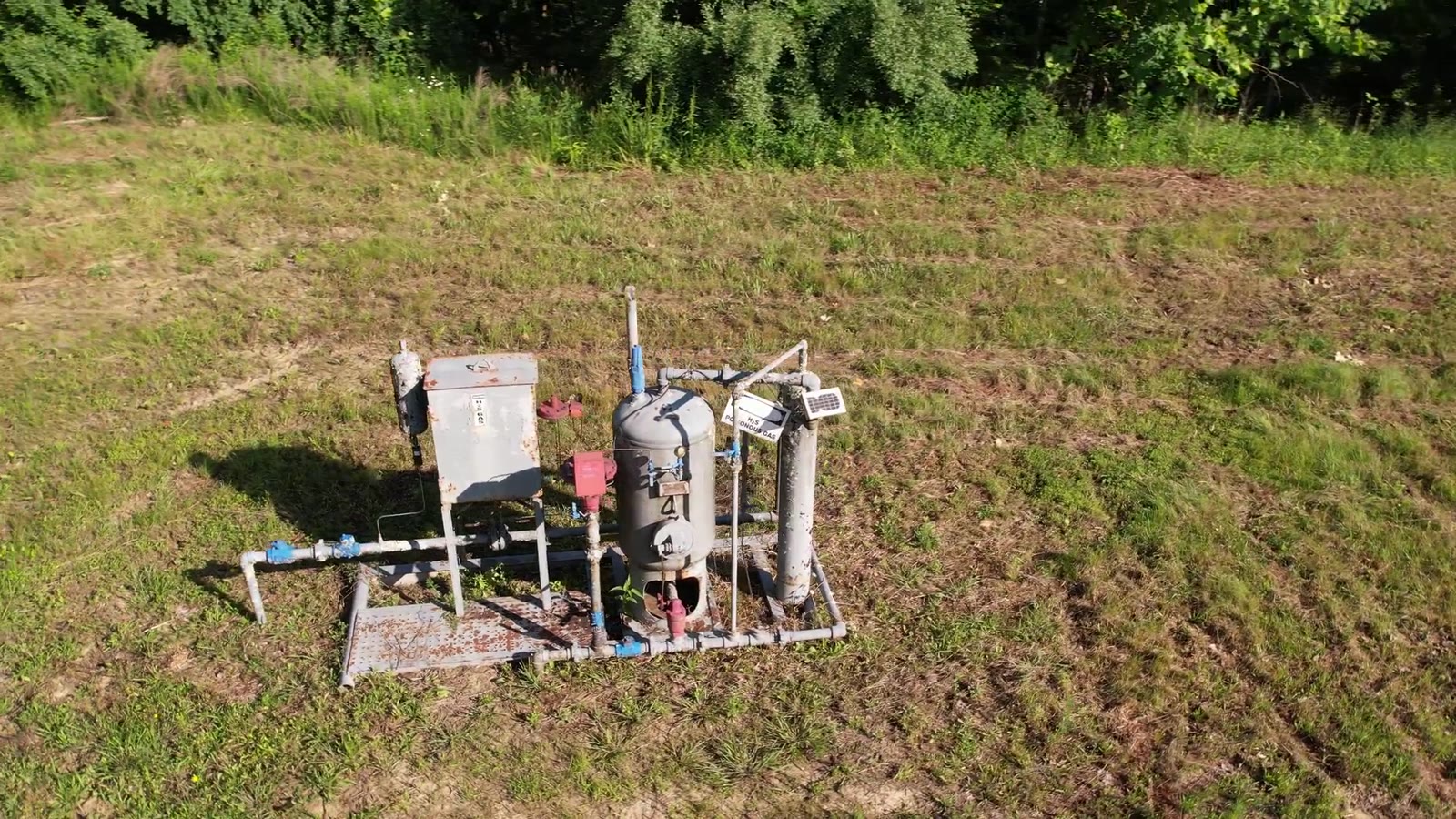
ClimateWells finances closing marginal wells years early. Each well is permanently plugged, and its emissions end at the source. For a data center operator, that means carbon credits you can retire against your footprint, and a local project your neighbors can see: cleaner air and safer land near your facility.
Every project creates high-integrity carbon credits. Our first projects are rated A by BeZero, with limited assurance from EY. In Wilmington, Los Angeles, we shut down seven aging wells beside a youth baseball field. In West Virginia, our project shut down wells near a local elementary school.
Already underway
Data center builders are already paying to plug wells. Oracle is funding the plugging of abandoned wells in New Mexico (Oracle). Amazon has pledged $1 billion for the communities around its data centers (CBS News). Plugging the wells next door is community spend that also cuts emissions.
We have data center projects in the works now, pairing new capacity with closed wells nearby.
Work with us.
Sources:
- The New York Times, AI data center pollution and carbon emissions, Nov. 16, 2026: nytimes.com
- Guidi, Dominici et al., Assessing the Carbon Emissions and Energy Consumption of U.S. Hyperscale Data Centers, Nature Sustainability, Nov. 2026: preprint
- AP, Study estimates magnitude of US data center pollution as climate talks unveil clean AI pledge, Nov. 16, 2026: click2houston.com
- TIME, Over 400 American AI Data Centers Use As Much Electricity As Wisconsin, Michigan, or Indiana, Nov. 16, 2026: time.com
- Heated, The first study of AI data centers' climate pollution is here, and it's a massive undercount: heated.world
- Lawrence Berkeley National Laboratory, 2024 United States Data Center Energy Usage Report: lbl.gov
- IEA, Energy and AI, Apr. 2025: DatacenterDynamics
- TechRadar, Microsoft admits its carbon emissions grew 25 percent in 2025: techradar.com
- Global Energy Monitor, Betting big on data centers, US now leads world in new gas power development, Jan. 2026: globalenergymonitor.org
- Omara et al., Methane emissions from US low production oil and natural gas well sites, Nature Communications, 2022: edf.org
- Data Center Watch, Q1 2026 Report: datacenterwatch.org
- RMI, Marginal Wells Map: marginalwellsmap.rmi.org
- Oracle, Oracle teams up with Well Done Foundation to plug abandoned oil and gas wells in New Mexico, May 20, 2026: oracle.com
- CBS News, Amazon to invest $1 billion in data center communities, Oct. 2026: cbsnews.com